Sniffy the Rat
I have seen rats killed by cats, dogs, reptiles, traps, and poisons. Although perfectly legal, all of these methods strike me as rather painful for the rat. Which begs the question, “Is there a painless way to kill a rat?”
After doing a bit of research, I found the answer and sent this announcement to the news media:
On Saturday, 6 January 1990, artist Rick Gibson will crush Sniffy, a live rat, between two pieces of canvas in front of Vancouver’s downtown library. The purpose of this free art lesson is to show shoppers how rats and other small animals can be cheaply and humanely killed for the sake of art.
Sniffy will be instantly crushed by a specially designed art-making machine. Gibson says, “I have invented an artistic technique that I want to share with shoppers. I checked with the Vancouver SPCA and I was told that my machine is both legal and humane. Sniffy won’t know what hit him and the result will be an artistic diptych.”
The artist got Sniffy from a pet shop which sells rats as live pet food for snakes and lizards to eat.
The art machine was mobile. It had four wheels and could be pulled with a rope. It also had signs that hung from a black shelf. One sign read, “FREE Art Lesson soon” and another read, “This rat is going to die.” A piece of white canvas lay on top of the shelf. Sitting on top of the canvas was a clear plastic cage with a live rat running around inside.

Suspended above the cage was another piece of white canvas attached to the bottom of a concrete block. The heavy block was held in place by a clamp. If the clamp was released, the concrete block would slide down a steel pole and crush the caged rat between the two pieces of canvas.
Shortly after receiving the press release, the Vancouver Province newspaper published this news story:
Animal lovers are vowing to stop the killing of a rat in the name of art.
John vander Hoeven of the Society for the Prevention of Cruelty to Animals (SPCA) admits he is powerless to charge Gibson unless the animal suffers.
“We are totally and utterly opposed to it, but if the animal is killed instantly it is legal,” said vander Hoeven. “There are certain animals that can be killed, and the rat is one of them.”
However, Peter Hamilton, the director of the Lifeforce animal-rights group, said:
“If Gibson plans to drop a brick on the animal, he’ll have to drop a brick on me too. We have a moral obligation to protect an animal that can’t defend itself.”
As the event day drew closer, public hostility towards me grew to a point where I became concerned about the rat’s safety. So as a precaution, I secretly gave the rat to a friend who lived close to the downtown library. Our plan was for my friend to safely return the rat to me on the day of the event.
However, on the morning of the event, while I was loading the art machine into the back of a truck, several people rushed towards me shouting, “We won’t hurt you.” Acting on instinct, I went inside the house and closed the door. I then heard these people go into the back of the truck and take the art machine.
After they left, I went outside, looked at the empty truck and phoned my friend who still had the rat. I told my friend that, since the art machine was gone, I couldn’t guarantee the rat a humane death. So we changed our plan: the rat would stay with my friend while I went downtown to end the event.
Since I no longer needed the truck, I used public transit. When I exited the Burrard SkyTrain station in central Vancouver, I unexpectedly met Paddy and Susi (Directors of the Pitt Art Gallery), who generously offered to walk with me to the library.
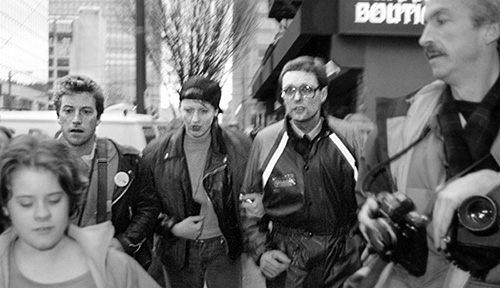
While we walked, they told me that Peter Hamilton had announced that “Lifeforce inspectors” had taken my art machine. Upon hearing this I said that I also wanted to make a speech.
When we got to the street in front of the library, we were met by a large crowd.
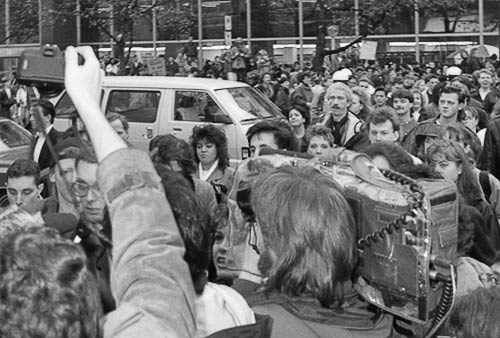
After pushing our way through the crowd, Susi and I climbed on top of a street planter.

Then, with all of my voice, I yelled:
This morning, as I was getting ready to come here, I was ambushed by some animal-rights activists, who I believe are concerned with saving Sniffy. I no longer have Sniffy. I have returned him to the pet store where I rented him from.
If those people are still concerned with saving the life of Sniffy, they should go to the pet store and get him. He is there now. Because maybe now as I speak, he is being purchased by someone to feed to their pet snake. So for those people who are interested in saving Sniffy, he is currently at the pet store on Davie Street.
After finishing my speech, I stepped down from the street planter and into a crush of police officers, journalists and protesters.

As Susi, Paddy and I tried to push our way out, we sensed that the police wanted us to leave, but the protesters and the journalists wanted us to stay and fight.
In fact, one protester grabbed me and said: “We should be getting you. The idea to kill a small mouse. You are a monster who should be sent to a camp and eliminated.”
To which I replied, “That’s fine, but go save Sniffy and all the other Sniffys in the pet store.”

While the protester and I talked, the crowd became more violent and started to punch Susi, Paddy and me.

So we ran. And while we ran, we talked about running to the Hotel Vancouver, entering its lobby and exiting out a side door. We hoped this tactic would slow down the mob that was now chasing us.
With a burst of speed, we ran to the hotel’s entrance and pushed against its doors. But the doors didn’t open because these were “pull-to-open” doors. At this point the three of us were flat up against the doors with an angry crowd right behind us. (And I think it’s about here where I wondered, “How did I get to this point in my life?”)
I was then grabbed from behind and pulled away from the doors and towards the mob. But then the doors opened and I was pushed into the hotel lobby, pulled around the reception desk and dragged into an office where the door was slammed behind me.
Inside the office I saw Susi, Paddy, and two plain-clothes cops whose job was to get me out of Vancouver.
After the introductions, the plain-clothes cops radioed the police in the hotel lobby to ask if it was safe for us to leave. But a police officer in the lobby radioed, “No. The lobby is full of protesters.” So we had to wait.

After waiting for about an hour, the all clear signal was given, and I was escorted out of the hotel and into a waiting police car, which drove me to the central police station.
At the station I was happy to learn that the crowd had dispersed peacefully and that no one had been hurt and nothing had been damaged. I was also told that my friend had successfully returned the rat to the pet store.
The next day the Vancouver Province newspaper reported:
Gibson returned the rented Sniffy to the pet store in central Vancouver, where it faced the grim prospect of becoming snake food.
The store owner then said, “Peter Hamilton of Lifeforce came into the store and asked for Sniffy. He said, ‘I am Peter Hamilton from Lifeforce — I want to buy Sniffy.’ So I sold it to him.”
Later that day, the Washington Post added:
Today, Sniffy is alive and well, residing in the home of an anonymous Lifeforce member.
The newspaper then quoted me as saying:
“What Mr. Hamilton saved was Sniffy the celebrity. What he should have done was bought every rat in the pet store. There are still lots of Sniffys in that store.”
The following week an editorial in the Ubyssey student newspaper said:
What Gibson really succeeded in doing, whether he meant to or not, was to expose the enormous amount of hypocrisy we are willing to accept in our daily lives. Many feel morally safe condemning Gibson but not many recognize the contradictions between their outrage at Sniffy’s premature death and eating meat.
About a month later, a policeman came to my house with the art machine in the trunk of his car. He said he had recovered the machine from Lifeforce and he’d give it back to me on one condition: I had to promise him that I would not criminally charge Lifeforce with theft, otherwise he needed to keep it as evidence.
After briefly thinking about it, I said, “I’ll take it now,” and together we carried the art machine back into my house.
The performance ended when we waved goodbye.